
Weekend Market Report- 11/1/26-Tech Wreck
It was a rough week for anything tied to the AI trade, and Friday made sure the damage stuck. The major indexes finished lower, but the real story was the split under the surface: a handful of large technology names got punished while the rest of the market largely held up or even advanced.
The scorecard
The S&P 500 closed at 7580, down 0.6 percent for the week. The Nasdaq Composite fell 2.0 percent to 25437. The Dow fell 0.85 percent to 51770. Small caps were the clear relative winner, with the Russell 2000 up 1.3 percent to 2812. The equal-weight version of the S&P also finished positive, underscoring how narrow the weakness was.
Monday through Wednesday were reasonably constructive. The Fed held rates steady at 3.75 to 4 percent on Wednesday, with two dissenters (Cook and Hammack) preferring another quarter-point hike. The statement noted that economic activity is expanding at a strong pace and that inflation remains elevated. Third-quarter GDP came in at a solid 3.4 percent annualized. Oil stayed elevated on ongoing geopolitical concerns, with WTI around 104. Yields eased modestly, with the 10-year finishing the week near 4.93 percent.
Thursday and Friday flipped the script. Alphabet had its worst single-day drop on record after its report raised fresh questions about the pace of AI spending relative to returns. Intel then collapsed nearly 29 percent on Friday after guiding fourth-quarter revenue below expectations, citing PC softness and manufacturing constraints. That was its worst day since the 1970s and dragged semiconductors and the broader tech complex lower. Amazon and several software names added to the pressure. Nine of the eleven S&P sectors still finished the week higher, with healthcare, materials, utilities, and consumer names among the relative bright spots. Small caps and equal-weight outperformance made it clear this was a rotation and a valuation reset in the heaviest AI names rather than a broad risk-off event.
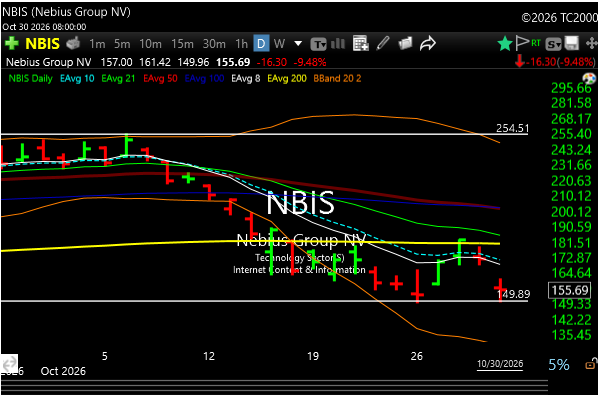
Among the names we follow closely, PLTR gave back about 6.4 percent for the week and closed near 184 after a sharp Friday drop. GOOGL was the epicenter of the damage. NBIS and other neocloud names stayed volatile, with some strong individual sessions earlier in the week that were later given back as the AI spending narrative soured. MU and the memory group remained under pressure overall, still well off their highs as investors questioned how long the current demand boom lasts and whether the buyers of that capacity can sustain the spend.
Looking ahead
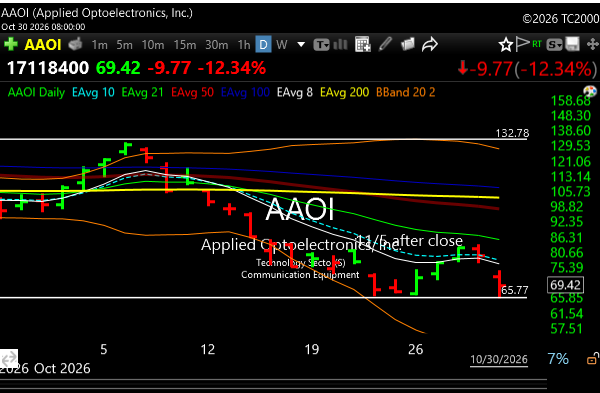
Next week is loaded. The midterm elections hit Tuesday, November 3. Markets have historically been choppy into the vote and firmer afterward as uncertainty clears, but the near-term focus will be on any signals around AI data-center regulation, power constraints, and broader fiscal or tax policy. Earnings will test the same AI spending and monetization questions that drove last week’s weakness. AAPL and PLTR both report after the close on Monday. TEM is also on the calendar early in the week ( I think Monday). AMD reports Tuesday, with ARM and QCOM later. Those results will matter for the entire semiconductor and AI infrastructure complex.
On the economic side, ISM manufacturing arrives Monday, services midweek, and the October jobs report on Friday. Consensus is looking for modest payroll gains and an unemployment rate around 4.2 percent. Several Fed speakers are also on the schedule. With rates on hold and inflation still above target, any labor-market surprise or further evidence on the durability of AI-related capital spending will set the tone.
The broader market showed resilience last week even as the highest-profile AI names were taken to the woodshed. That divergence is worth watching. If the earnings reports from PLTR, AAPL, AMD, and the rest can stabilize the narrative around returns on AI investment, the rotation that helped the equal-weight and small caps could reverse or at least pause. If the skepticism deepens, the pressure on the heaviest weights is likely to continue and could eventually spill more broadly. Volatility should stay elevated into the election and the jobs print. Position sizing and selectivity matter more than usual.
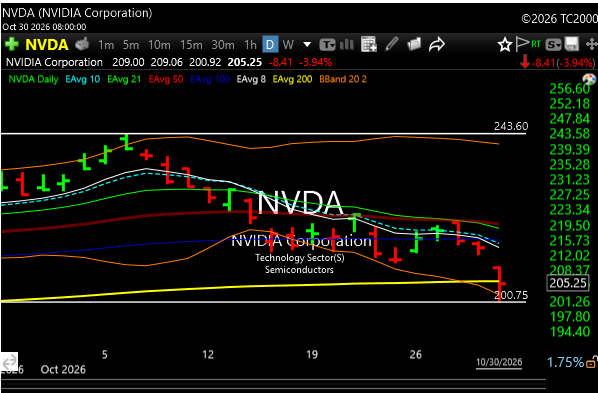
This tech market has been a demolition derby. Forget the indexes; we have stocks in the space down as much as 50% in a month, some less, but still horrible.
Fun fact………….There have been 15 years in history where QQQ was up at least as much as it is right now YTD, at the same point. Only TWICE was QQQ negative for the rest of the year from there. One of those was last year. The other was 2007.
Also, the Nasdaq 100 usually doesn’t fall below the 10-MMA twice in the same calendar year, and it already dropped below this moving average once in Q1.
Short interest in the Nasdaq 100 ETF, $QQQ, is up to 82 million shares, its highest since March 2023. By comparison, during the 2022 bear market, short interest in QQQ peaked at 90 million shares. So, are we there yet? Maybe close.
Traders piled in nearly $1 billion into a 3x leveraged (long) Nasdaq 100 ETF, TQQQ, after Friday’s 3.5% drop in $QQQ.
This is the fifth-largest single-day inflow on record. The last such spike came just a day before the 2025 bottom.
Anyone remember T Boone Pickens? He ran Mesa Petroleum, then later he ran a hedge fund. For a brief time, when he was at Mesa, he was my client. Anyway, never give up.
T. Boone Pickens was 70, clinically depressed, and down to $3.4 million. Two years later he was up $255 million. The eighties made him America’s most feared corporate raider, with his face on the cover of Time. Then he bet natural gas would hold at $2. It fell under $1. He kept paying out anyway. Mesa collapsed, his marriage ended, and his own lawyer told him he needed help. There’s a recording of him walking through it in a flat West Texas drawl, like a man reading a weather report. No spin. No “I saw it coming.” He names the exact number his fund fell to and the mistake that got it there. His rule: once you know the door that mashed your fingers, never put them back in it. At a pool table, he only ever took the straight shot, never the combination off two other balls. He rebuilt everything that way, one clean shot at a time. In 1999 the fund made $900K. In 2000 it made $255M. People assume his edge was a nose for oil or nerves of steel. After the comeback, he admitted he felt he’d never make a mistake again, and said he was wrong. The real edge: he treated a wipeout as a door to remember, not a reason to quit the table. Most of us replay the failed deal for a year. He studied it once, just long enough to never repeat it, and moved on to the next shot.
Watchlist names:
SPCX support 130, NVDA 200-190 zone, SOXX 460, QQQ bounced well off 200 EMA on Friday, so 683 level is support, VST support around 135, NBIS support 145, CRDO support at these levels, DRAM 45 zone, FG 19 level support.
Above are some names I am watching for nibbles, but I’m also aware of potential risk levels should things continue lower.
See you guys in the morning in our Discord room.